Common Dashboard Lights Explained
Is your dashboard trying to tell you something?
If any of your cars warning lights stay illuminated or flash while driving, your car's internal computer system has detected an active fault.
Modern vehicles rely on complex networks of computers, sensors, and microchips to operate safely. When a component deviates from its strict manufacturer settings, your vehicle's Engine Control Unit (ECU) logs a fault code and alerts you via your dashboard.
Our certified mechanics have the Engine Diagnostics tools and expertise to get you back on the road quickly and safely.
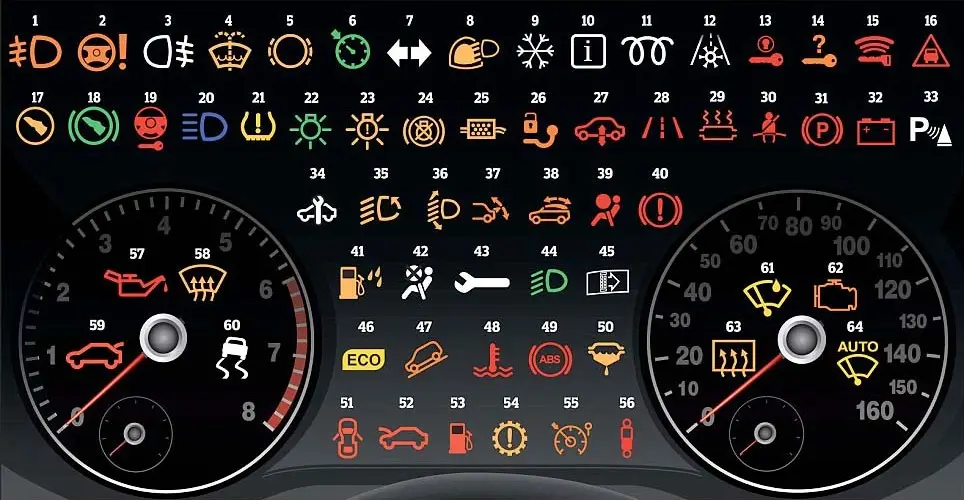
The image above and the explanations below teach you what the most common dashboard lights mean. Please note: Individual lights may differ by vehicle make and model.
- Fog light (front)
- Power steering warning light
- Fog light (rear)
- Washer fluid low
- Brake pad warning
- Cruise control on
- Direction indicators
- Rain and light sensor
- Winter mode
- Information indicator
- Glow plug/diesel pre-heat warning
- Frost warning
- Ignition switch warning
- Key not in vehicle
- Key fob battery low
- Distance warning
- Press clutch pedal
- Press brake pedal
- Steering lock warning
- Main beam headlights
- Tyre pressure low
- Sidelight information
- Exterior light fault
- Brake lights warning
- Diesel particulate filter warning
- Trailer tow hitch warning
- Air suspension warning
- Lane departure warning
- Catalytic converter warning
- Seat belt not on
- Parking brake light
- Battery/alternator warning
- Parking assist
- Service required
- Adaptive lighting
- Headlight range control
- Rear spoiler warning
- Convertible roof warning
- Airbag warning
- Handbrake warning
- Water in fuel filter
- Airbag deactivated
- Fault problem
- Dipped beam headlights
- Dirty air filter
- Eco driving indicator
- Hill descent control
- Temperature warning
- ABS warning
- Fuel filter warning
- Door open
- Bonnet open
- Low fuel
- Automatic gearbox warning
- Speed limiter
- Suspension dampers
- Oil pressure low
- Windscreen defrost
- Boot open
- Stability control off
- Rain sensor
- Engine/emissions warning
- Rear window defrost
- Auto windscreen wiping
Car warning lights vary by colour to indicate the severity of a mechanical or system issue.
- Red warning Light: For very serious issues and should be attended to by a certified professional. Red lights also remind you of an upcoming car maintenance.
- Yellow/Orange Light: It means a component needs servicing or repair. If it is flashing treat it with urgency.
- Green and Blue Light: This serves as a reminder that the system is actively operation well.
Not all dashboard symbols and car warning lights are universal; they vary by make and model. Some vehicles are fitted with more unique systems.
Over time with the increase in newer vehicle models, the range of car light symbols increases. We advise you to keep your owner's manual within easy reach to help you understand these warning signs.
Most common dashboard warning lights explained
Check Engine (MIL)
Action: Diagnostics RequiredThe Check Engine Light, or Malfunction Indicator Lamp (MIL), illuminates when your car's computer detects an issue with the engine, transmission, or emissions system. It can be triggered by minor problems, like a loose gas cap, or more serious ones, like a failing oxygen sensor or catalytic converter.
Solid/Steady Light: Indicates a fault is present. While it is not an immediate roadside emergency, you should schedule a diagnostic check as soon as possible. Ignoring a solid light can allow a minor issue to develop into a much bigger, more expensive problem over time.
Flashing/Blinking Light: Indicates a severe fault (such as an engine misfire). Pull over and stop driving the vehicle immediately. A misfire can quickly overheat the exhaust system and cause expensive, catastrophic damage to the catalytic converter or even lead to a fire.
Low Oil Pressure
Action: STOP ENGINE SAFELYCritical Danger. Your engine has lost vital oil pressure or running dry. Pull over off the road immediately and switch the ignition off. Operating an engine without proper oil pressure can destroy it entirely within seconds.
The “oil can” light (usually either illuminated in red or orange) can be one of two things; either the engine oil is running low or the engine has lost oil pressure. If this warning light is staying on, you need to have our mechanics investigate immediately.
Engine Overheating
Action: Pull Over safelyYour coolant temperatures have exceeded safe parameters. Continuous operation under high temperatures causes warped engine heads, blown head gaskets, or total structural metal lockups. Common causes are split cooling hoses or a failed radiator fan.
Other Engine temperature lights:
These lights are now more common, replacing the traditional temperature gauge.
A blue light will normally illuminate when the vehicle temperature is cold or still warming up and switches off when normal operating temperature is reached.
If the light is illuminated red or blinking it’s an indication that the cooling system is above the desired operating temperature threshold - when this occurs you need to get your car to us as soon as possible - continuing to drive could result in serious engine damage.
Battery Charging System
Action: Test Charging LoopThis light means your vehicle is relying strictly on stored battery power because the charging loop has broken down.
It usually points straight to a broken drive belt, a dead battery cell, or a failing alternator loop.
Anti-Lock Braking System
Action: Immediate WOF FailYour anti-lock braking controls have thrown an error loop. While normal stopping power typically functions, safety anti-skid aids are disabled. This causes an immediate WOF failure.
Tyre Pressure (TPMS)
Action: Adjust Tyre PressureThe Tyre Pressure Monitoring System has detected that one or more tyres have dropped below safe inflation ratings, or a wheel sensor has completely failed. Low pressure causes unpredictable handling, uneven tread wear, and increases fuel consumption.